The 50-share NSE Nifty stayed in the green for the most of the session and hit a high of 10,397.70, before closing at 10,379.35

Banking shares gained after the Reserve Bank allowed lenders to spread provisions for bond losses in the third and fourth quarters of the previous fiscal over the next four quarters.

The broader NSE Nifty climbed 61.60 points, or 0.58 per cent, to close at 10,772.05.

The finance ministry said the sharp inflows last fiscal were due to the government's policy initiatives and economic recovery.
Benchmark equity indices Sensex and Nifty ticked higher for the ninth straight session on Thursday, buoyed by fag-end buying in banking, financial and realty stocks amid encouraging domestic retail inflation data. Weak trends in IT counters and fall in the overnight US equity markets triggered by fresh concerns over recession, however, put a check on market's uptrend. In a largely subdued session, the 30-share BSE Sensex went up marginally by 38.23 points or 0.06 per cent to settle at 60,431.

FPIs would be classified into two categories instead of three, while the requirements for issuance and subscription of offshore derivative instruments would be rationalised.

However, in the last few sessions, the stock of Mukesh Ambani-controlled Reliance Industries Limited (RIL), hit its 52-week low level of Rs 2269.75, and has been one of the worst performers among the Sensex pack thus far in calendar year 2023 (CY23). Thus far in CY23, RIL has tanked nearly 11 per cent as compared to a fall of around 5 per cent in the S&P BSE Sensex. The fall in the stock, according to Gaurang Shah, senior vice-president at Geojit Financial Services is mostly due to the overall dip in the market sentiment, which in turn has impacted large-caps, including RIL.
The Reserve Bank said overseas investors, including FPIs and NRIs, can invest up to 26 per cent in insurance and allied activities through the automatic route.

Any investment proposal in India has to be cleared by the Cabinet which leads to a vicious cycle of approvals and rejections, says

The ideal time to invest in sector funds, is during a downturn so that investors can capitalise on a turnaround in 1.5 to 2 years.
Foreign investors have pulled over Rs 6,400 crore from the Indian equity market in the first four trading sessions of the ongoing month when the Reserve Bank of India (RBI) and US Federal Reserve raised interest rates. Given the headwinds in terms of elevated crude prices, inflation, tight monetary policy among others, FPIs' flows in India are expected to remain volatile in the near term, Shrikant Chouhan, Head - Equity Research (Retail), Kotak Securities, said. Foreign Portfolio Investors (FPIs) remained net sellers for seven months to April 2022, withdrawing a massive amount of over Rs 1.65 lakh crore from equities. This was largely on the back of anticipation of a rate hike by the US Federal Reserve and due to the deteriorating geopolitical environment following Russia's invasion of Ukraine.

Bajaj Finance was the top gainer in the Sensex pack, surging around 5 per cent, followed by Bajaj Finserv, HDFC, Tech Mahindra, HDFC Bank, UltraTech Cement and Tata Steel. On the other hand, HUL, Nestle India, ICICI Bank, Axis Bank, SBI, TCS and ITC were among the laggards.

Trading volumes for the equities cash segment remained soft, even as the benchmark indices rallied nearly 9 per cent in July. Meanwhile, volumes in the futures and options (F&O) market dipped marginally, but continued to hover at record levels. In July, the average daily turnover (ADTV) for the cash segment was Rs 46,602 crore, up 4.5 per cent month-on-month (MoM), but 26 per cent lower than the preceding 12-month average.

The benchmark Sensex is 2.4 per cent shy of a new lifetime high but the market capitalisation (m-cap) of all companies listed on the BSE is already in the record books. At Thursday's (August 18) closing price, the total m-cap of 4,776 firms on the BSE stood at Rs 280.5 trillion, surpassing the previous high of Rs 280 trillion on January 17. This, even if the Nifty Midcap 100 is currently 5.4 per cent below its lifetime high, while the Nifty Smallcap 100 index is down over 20 per cent.

Reserve Bank Governor Shaktikanta Das on Friday said 67 per cent of the decline in the foreign exchange reserves since April was due to valuation changes arising from strengthening US dollar and higher American bond yields. The forex reserves, which stood at $606.475 billion as on April 2, have declined to $537.5 billion as on September 23. It was also the eighth straight week when the reserves declined.

An appreciating rupee, unabated buying by domestic institutional investors (DIIs) and encouraging earnings by blue-chips contributed to the uptrend

The S&P BSE Sensex has gained 149 points to open at 25,802.

Banks and exporters preferred to reduce their dollar position on hopes of further capital inflows as foreign portfolio investors infused $107.22 million yesterday as per the record of Securities and Exchange Board of India.

'Historically, the markets tend to perform well during election years as governments aim to increase spending and call attention to growth.'
Gains were led by realty, auto, capital goods, banking, infrastructure, metals, power, oil & gas, PSU and consumer durables sectors, which rose up to 3.30 per cent.

SBI was the top gainer in the Sensex pack, spurting over 2 per cent, followed by TCS, Tech Mahindra, HUL, Bajaj Finance, Kotak Bank and Titan. On the other hand, IndusInd Bank, PowerGrid, Bharti Airtel, Asian Paints and HDFC Bank were among the laggards.

Indian Hotels reported strong consolidated revenue growth of 29 per cent year-on-year (Y-o-Y) in the third quarter of the current financial year (Q3FY25), led by revenue per available room, or RevPAR, growth of 15 per cent. The average room rate, or ARR, was up 13 per cent and occupancy improved 120 basis points (bps) Y-o-Y on a standalone business. Like-for-like revenue growth was 15 per cent Y-o-Y, while TajSats (airline catering) grew by 18 per cent Y-o-Y.

The NSE Nifty after shuttling between 10,408.65 and 10,224 points, ended 58.30 points, or 0.57 per cent, lower at 10,245.25.
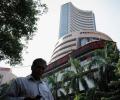
The Nifty too closed lower by 80.75 points, or 0.73 per cent, at 11,049.65 after hitting a low of 11,033.90.
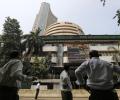
The broader 50-issue NSE Nifty too slipped from its record high, shedding 10.30 points or 0.09 per cent to end at 11,346.20.
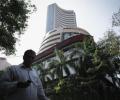
The broader NSE Nifty ended the session at 10,714.30, up 125.20 points or 1.18 per cent, after shuttling between 10,723.05 and 10,612.35.
.jpg)
Net investments by foreign investors in the equity market were $2.2 billion (Rs 13,166 crore) from July 1-25, while they amounted to $3 billion (Rs 17,829) in the debt market, taking the total to $5.2 billion (Rs 30,995 crore), as per the latest data.

Mutual funds focused on investing in fixed-income securities witnessed a heavy outflow of Rs 92,248 crore in June on uncertain macro environment, driven by expectations around an increasing rate cycle, higher commodity prices and slowdown in growth. This comes following a net outflow of Rs 32,722 crore in May and an inflow of Rs 54,756 crore in April, data available with Association of Mutual Funds in India (Amfi) showed. Out of the 16 fixed-income or debt fund categories, 14 witnessed net outflows during the month under review.

Maruti was the top gainer in the Sensex pack, rallying nearly 4 per cent, followed by PowerGrid, ITC, NTPC, SBI, M&M, Kotak Bank and HDFC Bank. On the other hand, TCS was the top loser on the Sensex, shedding over 6 per cent.
From the Sensex pack, State Bank of India, Axis Bank, IndusInd Bank, Tech Mahindra, HCL Technologies, Tata Consultancy Services, Maruti Suzuki, Tata Steel and Tata Motors were the major gainers. Power Grid and HDFC Bank were the laggards from the pack.

'Higher inflows into these securities should lead to lower borrowing costs for the government.'

Other gainers include ONGC, Bajaj Auto, Kotak Bank, TCS, Tata Steel, Axis Bank, Maruti, HDFC and HUL, surging up to 3.03 per cent.

The NSE Nifty, after shuttling between 10,698.35 and 10,587.50, finished the session 91.50 points, or 0.86 per cent higher at 10,684.65.

This is its biggest single session gain since April 5, when it had surged 577.73 points.

'Investing abroad helps mitigate currency risk for foreign-currency denominated goals, such as children's higher education and international travel.'

To further tighten its control of practising accountants, the Centre has brought within the ambit of the Prevention of Money Laundering Act (PMLA) their "financial transactions" such as operating and managing their client firms and trusts, and buying and selling business entities. The Union finance ministry issued a gazette notification on this on Wednesday. Under the new rule, chartered accountants, company secretaries, and cost and works accountants carrying out such transactions (on behalf of their clients) will now be required to go through the Know Your Company (KYC) process before commencing work.

More companies are harbouring aspirations to go public, following a sharp market rebound after June's nadir. In August, seven companies expecting to raise a cumulative Rs 10,425 crore filed their draft red herring prospectus (DRHP) with the Securities and Exchange Board of India (Sebi). The amount they are looking to mop up is the highest since March, when 13 companies filed their DRHPs to raise a combined Rs 19,494 crore, reveals data provided by PRIME Database - a source of comprehensive information on all capital market offerings.

HDFC and HDFC Bank were the biggest losers in the Sensex pack, plunging 5.09 per cent and 3.32 per cent, respectively, after the private bank reported a rise in non-performing assets.

'The problem is that the bubble may not only be in valuations, but also in investors' minds.'
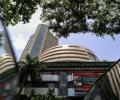
The NSE 50-share index, after moving between 10,572.20 and 10,546.20, ended at 10,565.30, up 39.10 points, or 0.37 per cent.
